Writings
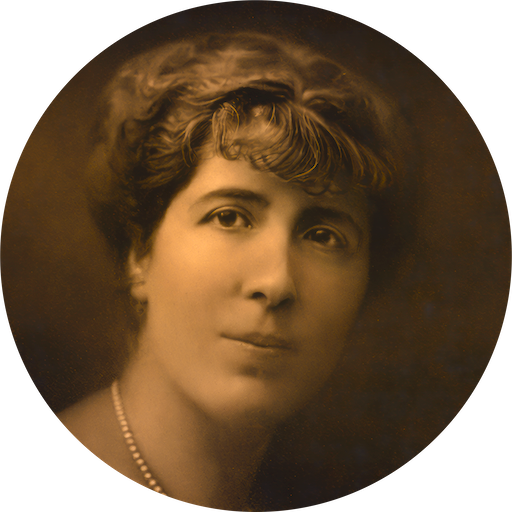
Charlotte Sohy was not only a musician — she was also a writer.
As early as 1905, at just eighteen, she wrote the text of her Berceuse triste, Op. 1, where a mother’s anxiety for her child mingles with the longing for an absent father and the muted threat of the call of the sea..
This was followed in 1908 by the lyrics of her Chants de la Lande, Op. 4, where bards, sprites, fairies, and wandering souls inhabit a fantastical world steeped in Breton legends.
In 1911, she wrote the text of her Poème, Op. 8, for contralto, baritone, choir, and orchestra: a meditation on a plain once ravaged by battle and now fertile again, where the voices of fallen soldiers return to soothe an old man haunted by their memory — a text which, composed on the eve of the First World War, resonates today with particular force.
She then wrote the libretto for Bérengère, a lyric drama composed by her husband Marcel Labey, before writing the libretto for her own lyric drama, Astrid, inspired by a short story by Selma Lagerlöf.
Her Méditations, Op. 18, appeared in 1922: three pieces of spiritual and intimate character, in which the soul yields to trust in God through images of water, childhood, and rediscovered light.
In 1938 came her Conseils à la mariée, Op. 26, where she reveals her sense of humor, slipping in — with tender mischief — the subtle art of guiding a husband without his noticing.
Finally, in 1953, she wrote and composed the Cantique à Sainte Claire, Op. 35.
But her literary talent extended far beyond music. Charlotte Sohy also left numerous writings — memoirs, short stories, a novel, several plays, and even a film script — rediscovered in a box kept by her daughter Gisèle, labeled Souvenirs de mes parents.
Recollections
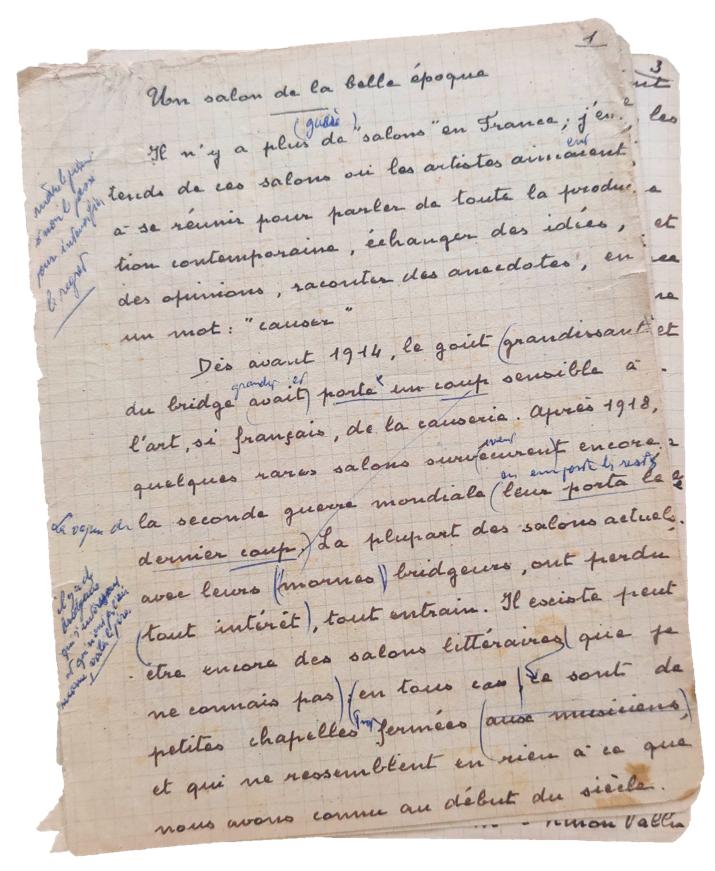
The salon of Mme de Saint-Marceaux
From 1909 to 1930, Charlotte Sohy and her husband Marcel Labey were regular guests at one of the last great Parisian musical salons: that of Marguerite de Saint‑Marceaux. Every Friday evening, in her private townhouse, this renowned salonnière gathered — in a lively, informal atmosphere — some of the most prominent artists of the Belle Époque and the interwar period: Fauré, Ravel, Debussy, d’Indy, Messager, Roussel, and many others, who came to play, listen, or simply converse among peers.
In 1954, at the age of sixty‑seven, Charlotte Sohy set down her memories of those evenings: Ravel trying out the piano reduction of La Valse, Messager moved to tears by the Tristan prelude, a memorable blunder over a Monteverdi translation in front of her teacher Vincent d’Indy…
Published here in full for the first time, this text is the only written account in which Charlotte Sohy speaks about music — though never about her own. It is a precious document, illuminating both the artistic effervescence of a vanished salon and the discreet yet active place Charlotte Sohy herself occupied within it.
Paris-Perros-Guirec, 1944
In late June 1944, while Paris remained under German occupation after the Allied landings, Charlotte Sohy and her husband Marcel Labey took twelve days to leave the capital and reach their daughter Josette, who had taken refuge near Saumur. The journey, full of comic mishaps, involved makeshift trucks and even a wheelbarrow lent by a miller. After six weeks of respite with the Dominican sisters of Blou — punctuated by a few concerts given for the community — the couple set off again at the end of August to return to their house in Perros‑Guirec, Brittany, encountering yet more adventures along the way.
Charlotte Sohy recorded this double journey with verve, in a text intended for her grandchildren, “known and unknown.” A lively, humorous account that ends with the relief of finding their Perros home intact — spared, Charlotte believed, by the protection of Notre‑Dame de la Clarté.
Novel and Tales
Marie-Claire de Lucigny
NOVEL
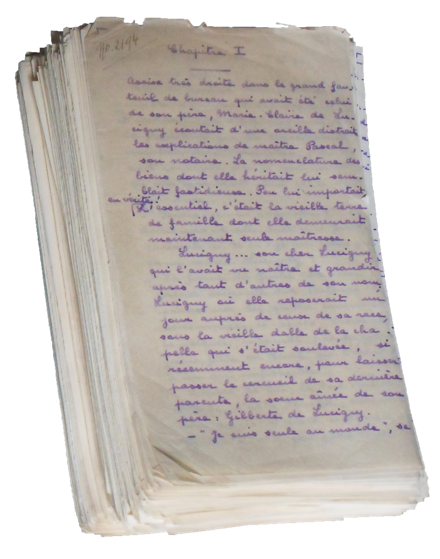
Marie-Claire de Lucigny immerses the reader in the high society of the early twentieth century. Raised in solitude after her aunt’s death, the heroine discovers at the age of twenty that her mother—whom she believed long gone—is in fact alive, a worldly and elegant countess living in Paris. Music accompanies Marie‑Claire at every turn of this new life: at a society dinner, she astonishes the guests by volunteering on the spot to replace a missing accompanist, earning a success that sparks as much jealousy as admiration; later, it is through her impassioned performance of Beethoven’s Sonata « Pathétique », which deeply moves her listener, that she reveals for the first time the depth of her feelings.
But beyond the plot, the novel reveals above all the intimate world of its author. Charlotte Sohy transposes into it her own universe: Parisian salons, the art of declamation, religious fervor, her passion for music and literature, and life at the Château du Buisson de May. Marie-Claire de Lucigny thus emerges as a work where imagination and life intertwine, offering the reader a vivid portrait of Charlotte Sohy herself.
Old Years - Young Faces
TALES
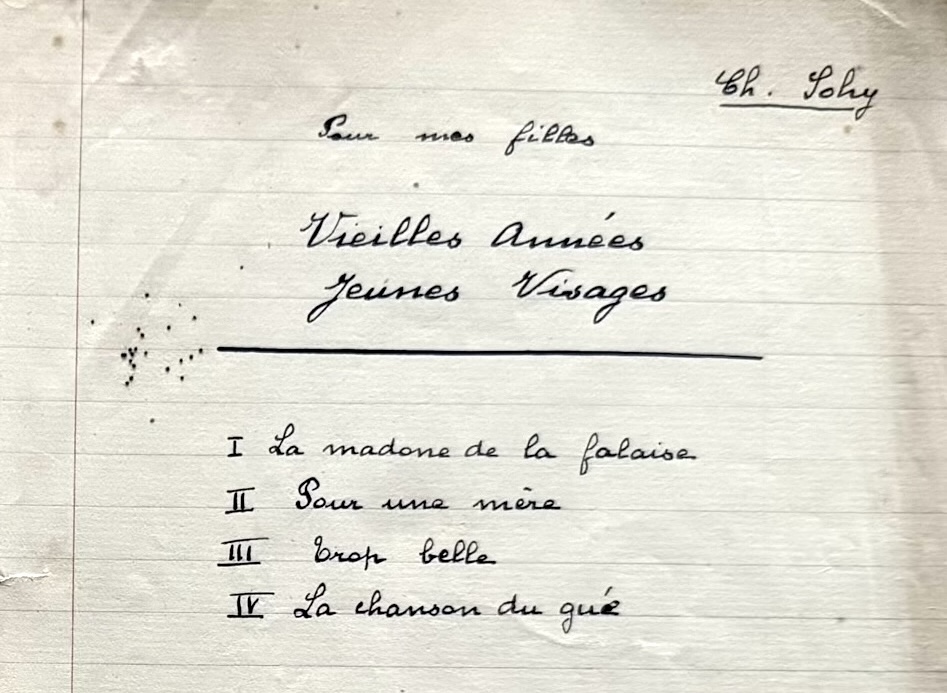
The Madonna of the Cliff – For a Mother – Too Beautiful
Gathered under the title Old Years – Young Faces, these three tales were written by Charlotte Sohy in a school notebook belonging to her daughter Hélène. The title page announces four stories, but the last one, The Song of the Ford, is lost — or perhaps was never written.
Each tale unfolds in a distinct historical setting. The Madonna of the Cliff takes us to early‑twentieth‑century Brittany, where the life of an old sailor is upended after his granddaughter’s accident. For a Mother is set during the Carlist Wars in Spain and follows a young girl confronted with the violence of conflict. Too Beautiful transports us to a Middle Ages tinged with the supernatural, where love collides with appearances and social conventions.
Despite the diversity of periods and settings, these stories are bound by a common thread: the transmission of moral and spiritual values to her daughters. Charlotte Sohy’s Christian faith, central to her life, permeates the narratives without weighing them down, giving their endings a tone that is at times grave, at times luminous.
Theatrical Works
Formed from childhood in declamation and theatre under Mme Dupont‑Vernon, the young Charlotte Sohy developed early on a deep love of the stage. She performed in numerous plays at society evenings and charity events, and this practice became one of the enduring threads of her life. Her daughter Josette recalled her ability to move an entire room by the sheer power of her voice, drawing on a repertoire ranging from Rostand to Catulle‑Mendès and La Fontaine. Later, Charlotte continued to recite these texts, as during the 1944 journey from Paris to Perros‑Guirec, when she interspersed an improvised concert with monologues from her “old repertoire.” From this long‑standing familiarity with the stage arose, quite naturally, her desire to write plays of her own.
Nell
Co‑written between 1905 and 1910 by Charlotte Sohy and her brother André, Nell unfolds within the English aristocracy. Nellie Landsborough, an orphan under the authority of a domineering uncle, is promised to Duke Humphry Warlington, though she harbors feelings for his younger brother, Rex. Between society conversations, tennis matches, and family pressures, the play deftly explores the conflict between inner freedom and social convention.
The Good Wound
Set during the First World War, The Good Wound follows Mme Reversan and her nieces, Edith and Liliane, in a house transformed into a field hospital. Devoted and steadfast, Edith keeps watch over Jean — Liliane’s fiancé, gone to the front — through her letters. Liliane, drawn to a wealthy convalescent, hesitates between loyalty and ambition. Jean’s return reveals the fragility of promises and sets Edith’s constancy against her sister’s fickleness, against a backdrop of intimate upheavals brought on by the war.
The Marriage of the Viscount of Boomshire
Written in the 1920s for her four eldest children, this one‑act comedy features Madame Potiron, determined to marry her niece Geneviève to a country viscount. Between social ambitions, misunderstandings, and the plain‑spoken wit of the maid Aldegonde, the play pokes fun at pretence and celebrates sincerity. Light and lively, it belongs to the tradition of théâtre de société that Charlotte Sohy so enjoyed.